Thursday, January 1, 2026

Tales from the Logbook--Rights to the Reef


The Guardian newspaper recently featured an on-line article, Fiji wrestles with plans to restore Indigenous rights over world-famous surf breaks.  The story relates how the Fijian government is seeking to return customary rights to govern marine areas – known as qoliqoli – back to the Indigenous people.  This move would allow those people “to be compensated for tourism operations on the reefs and fishing grounds that have formed their livelihoods.”

The article notes that “until 2010, access to Cloudbreak, one of the world’s most famous surf waves, was barred to Fijian locals, due to an exclusivity deal with a high-end resort from the early 80s….In 2010, the Frank Bainimarama-led military dictatorship introduced a surfing decree, banning payments for the use of Fiji’s reefs, lagoons and beaches, and putting an end to all exclusivity deals….The Bainimarama decree meant open season on the waves for tourists and locals. This gave rise to a crop of young surfers, including Fiji’s first professional surfer – but trampled over customary marine rights, cutting (Indigenous people) out of decision-making or profits as foreign-owned resorts sprang up and surf tourism boomed….Now, the Fijian government wants to return the rights to govern marine back to the Indigenous people, allowing (them) to be compensated for tourism operations on the reefs and fishing grounds that have formed their livelihoods.”


Reading the article reminded me a visit to a Fijian village, Somosomo, while on a dive trip aboard M/V Naia in October 2017.  During the visit, the village leader during our welcoming ceremony explained that the residents are the “traditional guardians of the reef” and that its resources provide much for the village.  I sensed a protection ethic among the people and pride in their stewardship role.  I spoke and thanked the village for their guardianship as it had allowed us to see many wonderful sights.

Prior to departing Alaska to travel to Fiji and following the advice in the information packet provided by Naia, I purchased a number of school supplies for the village including pencils, crayons, and coloring books.  The coloring books I chose had an Alaska theme.  I wonder sometimes if those items resulted in amazement and wonder for some of the youngsters about a place cold and snowy. 

During our tour of the village, we learned that the older children are sent to a neighboring village during the week to attend school.  During our visit, we met mostly younger children of what I would guess would be preschool age.  They were very shy at first.  One of them approached me and motioned that she wanted “up”.  I lifted her to face level, said “hello, my name is Jim, would you like to go higher?” at which point I lifted her into the air above my head while saying “wheeeee.”  The resulting giggles proved that laughter is the universal language.  It also attracts other children who want to enjoy the same experience.  Suddenly, I am surrounded by children all waiting their turn.  It was wonderful.  I am also thankful for my weightlifting routine at home that included overhead presses.


We did encounter a form of “exclusivity” offshore of the privately-owned Wakaya Island, home to the Wakaya Club and Spa.  On October 15, 2017, we anchored in a bay a distance from the Club but still within sight of the buildings and boarded the tenders for a quick ride to the dive site.


We descended the 100-foot wall to find the den of the blue scorpion fish.  As part of the group, my buddy and I waited our turn to approach the den.  By the time our turn came, the fish had become spooked and pulled back into its hole.  The rest of the dive was spent checking out other life along the wall, such as the abundant anemone fish and the regal lionfish.  While I was observing a pipefish, my buddy pointed out a resting white tip shark.  It was a wonderful dive, 98 feet for 47 minutes.


Upon returning to the boat, we were informed of the need to relocate to another anchorage.  The resort had contacted the boat during our dive and objected our presence stating that their area was private and exclusive.  The skipper insisted that he had an email from the Fisheries Department stating that the boat could anchor in that location.  The resort responded that an email was not sufficient; they wanted a formal letter issued by the Fisheries Department. 

Apparently, the resort was concerned about the privacy of its guests.  We had many dedicated marine wildlife photographers on board not paparazzi taking pictures of their guests for the tabloids.  We moved to another spot since we were done with the dive and to avoid any further hurt feelings or complications.  According to Wikipedia, guests on the island have included  “Nicole Kidman and her husband Keith Urban, Bill Gates and his wife Melinda, Steve Jobs, Rupert Murdoch, George Lucas, Michelle Pfeiffer, David E. Kelley, Robert Zemeckis, Paris Hilton, Tom Cruise, and Keith Richards (who was hospitalised after falling from a coconut tree).”

According to their website, the current rate (2025) for a visit ranges from $2,500 to $11,000 per night for two guests with discounts for multiple day stays.  

Thursday, December 18, 2025

A Tonka Truck for Christmas

Christmas Day, 1960, stands out in my memory for one reason—I wanted a Tonka pickup truck more than anything else.  I was five years old.  Tonka trucks were real and rugged, not like the wood and plastic vehicles I had up until then.  I asked Santa for this particular toy.  It topped my list. The story of how I came to get the truck is one of my fondest Christmas memores.

The Lead Up to Christmas

Mom made Christmas really special, all while raising a family that eventually expanded to six children.  She baked, decorated, bought and wrapped the gifts.  She would send out the Christmas cards, dozens of them it seemed, written and addressed in her neat cursive hand writing. Penmanship was prized. (Christmas cards and even the long distance phone calls to absent family members seems a declining pastime in a world of instantaneous messaging and holiday emojis.  The annual Christmas letter, explaining what had happened since the previous year’s letter is a vanishing tradition).

The weekend before Christmas was reserved for decorating.  Dad would hang the wreath, bring the tree up from the basement, place it in the stand, and turn the adjusting  screws to hold it firmly and vertically in place.  He would plug in the string of lights and sometimes get very frustrated when he could not find the burned out bulb that killed the illumination of the entire string.  (Prior to the mid-1960s, our light strings were wired in series.  If one bulb burned out, the entire string would not light until the offending bulb or bulbs were found and replaced.)  Once lighted, he would wind the lights around the tree and place the angel atop.  Water needed to be placed in the reservoir of the stand immediately and every morning thereafter or the tree would dry out.  Municipal fire departments warned that dry trees would catch fire from the heat of the bulbs. 


Everything else for getting the tree decorated was mom and kids happy task. We had to be careful hanging the glass ball and more intricate ornaments.  Wire hooks atop the ornament held them firmly to the tree.  We would then set up the manger, placing the figures of Baby Jesus, Mary and Joseph at the center.  We then found places for the  supporting cast of angels, shepherds, wisemen and livestock.  After all that, it was time to bake cookies.  Mom would roll out the cookie dough on the cutting board using a cloth sleeved rolling pin.  We would use holiday-themed cookie cutters to cut the dough, decorate each cookies.  Mom would put them in the oven.  The smell of baking cookies would fill the house. 


Mom used to say that as kids we had “three Christmases.”  First, on Christmas Eve, we would open gifts from family members—siblings and out-of-town grandparents, aunts and uncles.  Second, after we were asleep on Christmas Eve, Santa would come (my parents getting items out of the attic and placing them under the tree or in our stockings), which the kids would behold with awe on Christmas morning.  Third, on Christmas Day, in-town relatives would come by the house on Marion Street or we would go to my cousin’s house a few blocks away, bearing even more gifts. Christmas was one of the two times a year we would receive gifts of toys (and clothes), the other being our birthday. 

December 25th, 1960

Early on Christmas morning, shortly after my parents turned in, we three kids, Johnny, Mike, and I, awoke and began to reconnoiter the toys Santa had left under the tree in the living room.  Santa’s gifts were never wrapped.  His presents were the best of the three Christmases.  We were not allowed to go into the living room until my parents said we could go. But, if we turned on the light in the bathroom halfway between the bedrooms and the living room, we could make out the edge of the toys until the dim light was swallowed by the living room’s darkness.  Each one of us would go out and in turn report back to the others on what little we could see.  My dad would inevitably yell for us to “go back to sleep.”  I doubt that we ever did.  We would repeatedly ask “can we get up NOW?”  After repeated queries and an exasperated affirmative grunt from my dad, we would race down the hall and into the living room.  We turned on the lights and momentarily stood in awe of the bounty, trying to figure out which toys belonged to whom.


I looked for my Tonka truck but could not see it.  I rummaged around desperately looking for it.  Where could it be?  I looked everywhere under the tree.  I looked in those sections my brothers had claimed as theirs.  It was nowhere to be found.  I had lots of other toys, just not the one I had my heart set on.  Santa had let me down. I began to cry. “I didn’t get my truck.” 

I was inconsolable.  How could that happen especially after I had left him milk and cookies and a sliced apple for the reindeer?  My older brothers stopped their own rummaging and came over to help, showing me all the other great toys Santa left.  At some point, I realized the truck wasn’t going to drive up.  I moved on to the treasures that had been left, still hoping the truck would be found.

Too soon the fun our toy revelation ended. We had to get ready for Christmas Mass at Saint Margaret Mary Parish and celebrate the true reason for the day.  We scooted into our new 1960 Chevy station wagon.  I felt very safe in that vehicle compared to the old Mercury it replaced.  When the back seat floorboards rusted through and holes appeared,  dad reluctantly concluded it was time to get a new car. 

The rest of the day has faded into the shadows of a five-year-old’s memory.  I assume that it followed the regular pattern of our Christmas Days thereafter.  Utmost was the phone call to my dad’s parents on the East coast, trying to get an open line on our home phone’s party line and then trying to get a long distance circuit.  After the call, the kids played with toys, mom prepared Christmas dinner, dad played host and bar tender to friends and relatives that came by.  The men drifted into the basement, the kids to the living room, the women congregated in the kitchen.  We lived in a 900 square foot, three bedroom, one bath, ranch style home.  Between people, gifts, and food, there was not a lot of room to spare.

December 26th, 1960


When I awoke the next morning and went into the living room I beheld one of the most beautiful sights in my long five year life.  Under the tree, I spied a shiny, brand new beige-color Tonka stake bed truck.  I was happily confused.  Had our searches the day before not been thorough?  A note attached to the truck, read to me by my mom, explained.


I had my truck. I was happier than I had ever been and maybe ever since.  If anyone needed proof that Santa was real, that note proved it. 

For many years after learning the true nature of Santa, I assumed my dad had scoured the city Christmas Day night to find the toy truck. Then I realized that in 1960, no place in the City of Milwaukee was open that would have carried that toy.  I was well into adulthood when I asked him where he found it. 

“Oh yeah,” he responded, “you blubbered your eyes out over that damn truck.  We had bought it early to make sure it would not sell out and you would have it.  We put it in the attic.  When we went to get the toys, it got covered by the access panel.  I knew that it would still be in the attic that Christmas morning, but I couldn’t get away to get it down.  I got it down Christmas night when you were all asleep.”

 I am pretty sure dad wrote the note; it has a neat blueprint lettering quality to it.  Mom saved it.  I did not see it again until after she passed when dad sent me the items she saved—baby  books, every school picture taken from kindergarten through high school, every report card, school programs, and other items that moms collect regarding their kids.  Dad saved tools, fittings, nuts and bolts, scraps of wood and screws.  Mom saved mementos.

Closing Thoughts

As I look back six decades later, I realize that Christmases around our house were wildly indulgent.  I wonder if that was so because of the sparse Christmases our parents experienced as Great Depression era children.  I recall being told that my fraternal grandfather, a carpenter and later house builder, would make the toys my dad and his brothers received at Christmas.  My mom would relate how some winter months they had to take their wagon to pick up “County coal” to heat the house.  

In 1960, our standard of living was great for two adults and four children. (My younger brother, Bob, was born earlier that year.) My dad probably made about $6000 a year from his job as a draftsman at the AC Sparkplug facility in Oak Creek.  After being discharged from the US Army Air Forces after the war, he used his GI Bill benefits to attend the Milwaukee School of Engineering.  He received his associate degree in technology, got a job, married my mom, and started a family. He purchased the home, again using his GI Bill benefits, the year I was born.  Everyone in the neighborhood had similar stories.

We lived frugally.  Kids received gifts twice a year, on our birthday and at Christmas.  For our birthdays, we surgically removed the wrapping paper so it could be reused for other birthdays.  At Christmas, we were allowed to tear the wrapping paper off the box.  Gifts from the out-of-town family members usually meant clothes from Gimbels Department Store or the Boston Store.  Mom would buy these items with money that was sent by relatives, place the items in Gimbels/Boston Store shirt boxes, and wrap and label each one.  Mom appreciated the durable construction of a gift box.  Those shirt boxes were more indestructible than the gifts they contained.  I think we used them annually well into the 1990s. I have one from the Boston Store that has to be at least 50 years old. 

Yeah, dad knew how to make Christmas; mom really knew how to make Christmas special. 


They always insisted that they really wanted nothing from us for Christmas.  What they really wanted as we grew into adulthood was for us to spend a little time with them, not much, come by just long enough for a visit and a meal.  Time was the one thing that I thought in the moment was in short supply; there would always be more time “later.”  Later rarely makes up for the time owed.  

What I would not give today if I could hug them and say “Merry Christmas, Mom and Dad.  Thank you for everything”

Thursday, May 15, 2025

Dennis Divins--A Truly Remarkable and Unforgettable Character


As I think of the unforgettable characters that I have met in my four decades of scuba diving, Dennis Divins standsout as one of most unforgettable characters.  I was recently reminded of this when my Facebook Memories tab reminded me that Dennis passed away on May 14, 2013.

I first met Dennis when I enrolled in a Rescue Diver course in 1985 at the University of California, Santa Barbara.  Dennis was the Diving Safety Officer and co-taught the course with Ed Stetson.  I have been blessed in having several mentors as a diver over the last four decades, Dennis is first among equals.  He was a real professional and demonstrated by example what it was to be a professional.  He was a hell of a waterman, as I was to learn in several expeditions with him to the island and coastal reefs. 

In almost every aspect of my diving, Dennis had an influence; he was a friend and teacher.  In his capacity as Diving Officer, Dennis taught the Research Diver Certification course.  I took the course from him before I enrolled as a graduate student at UCSB.  That training enabled me to volunteer with the National Park Service, experience that led to my eventual employment as a maritime historian at Channel Islands National Park.  I volunteered to help teach openwater diving as an assistant instructor through UCSB Outdoor Recreation, service for which Dennis always expressed his appreciation.  During graduate school, I was a member of the Diving Safety Control Board and worked with Dennis on a variety of issues.  I also helped him teach a couple of segments of the 100-hours class.  I recall one exercise he had us undertake was to mow the kelp off the pipes that connected the offshore water intake to the marine lab--a great learning experience and a lot of fun.

Dennis had been a fixture in the Santa Barbara diving community since the 1960s.  It seems like everyone I met knew him and respected his contributions. 

Certified as a scuba diver in 1961, Dennis spent the next five decades becoming progressively more involved with diving in the underwater sciences.  He would train thousands of divers, spend countless hours underwater conducting research dives in locales ranging from tropical coral reefs to the Antarctic ice shelf, make valuable contributions to the professionalization and management of scientific diving programs all while helping to transform a small regional university marine laboratory into a world-renowned institute.  A well-earned collegial recognition of his accomplishments came in 2012 when Dennis received the American Academy of Underwater Sciences’ (AAUS) Conrad Limbaugh Memorial Award for Scientific Diving Leadership.

In the mid-60’s, Dennis worked at a number of marine-related jobs including collecting marine organisms for the newly established University of California Santa Barbara (UCSB) marine laboratory.  In 1967, he received a scientific diver certification from the UCSB Diving Safety Officer (DSO) Don Duckett.  For the next two years, Dennis worked as a diver in the interpretation program at the Undersea Gardens, a floating marine aquarium in the Santa Barbara Harbor.

 Dennis’s affiliation with UCSB diving program started in 1970 when as a newly-designated NAUI diving instructor, he became the university’s DSO.  Within three years, he completed certification as an American Red Cross CPR instructor and obtained certification as a scuba diving instructor from two additional organizations, PADI and NASDS.  During the NASDS certification course, friend and fellow scuba instructor Bernie Campoli recalled, “Dennis became the course’s ‘Honor Man’ after rescuing a few  other instructor candidates from the mid-west who had never before been in the ocean.” 

Throughout the 1970s, the UCSB DSO was a part-time position. Dennis, in addition to his duties as the DSO, worked as a university ambulance attendant and Santa Barbara County firefighter until the DSO became a full-time position in 1979.  The following year, he testified at the Los Angeles hearings conducted by the Occupational Safety and Health Administration on establishment of the scientific diving exemption from commercial diving regulations.  Creation of the exemption and the expanding opportunities for ocean science research caused proliferation of scientific diving programs.  Through his work with AAUS, Dennis contributed greatly to the practice and administration of scientific diving. 

For the next quarter century, Dennis worked as a tireless advocate for the UCSB diving program, adapting evolving technologies and techniques into the program to ensure operations were conducted safely.  While his work took him to a variety of locales, the Santa Barbara Channel Islands were his very favorite because of their wide variety of species and overall beauty.  As a consummate waterman, he had a unique appreciation of the aquatic environment’s nuances.  Shane Anderson, a retired UCSB staff diver, recollected that during dives at the Channel Islands to guage the recovery of Giant black sea bass (Stereolepis gigas), Dennis could seemingly summon the fish by rhythmically rapping a dive knife against the base of his scuba tank and have them remain motionless for the longest time.

I think Dennis’ greatest contribution may be the thousands of rigorously-trained, disciplined scientific and sport divers (including his wife Sherry). His legacy is the way he inspired countless young scientists to pursue their careers and influence he played to so many of the people he befriended.  Dennis not only instilled safe diving practices in people, he infused an appreciation and enjoyment of all aspects of diving and the ocean.  

The accompanying picture is of Dennis in 1985.  I had just received my assistant instructor certification and was helping teach my first class.  Dennis was on our boat trip out to Anacapa Island.  After one dive, when we got back to the boat, I mentioned to Dennis that a  barracuda had shadowed my group as we approached the stern. On hearing that, he grabbed his spear gun, fins and snorkel and hoped into the water. Next thing I know, he comes back with a fine specimen for the evening's dinner.  Like I said, he was one hell of a waterman and a very good friend. 

I recall on instance when in 1989 Dennis needed to purchase a couple of oxygen units for the small boats the University used for research dives.  Budgets were tight back then and he just did not have the funds to purchase the much needed units.  I was speaking with him in his office of Environmental Safety and Health one afternoon about the problem. I predicted that as a result of the recent Loma Prieta earthquake money would be made available for “emergency preparedness.”  The key, I noted, would be to frame the request for portable oxygen units in those terms, not as units for the boats.  It would not be a stretch to do so.  I reminded him that the University’s Thunderdome became the evacuation center earlier that summer when the Paint Fire closed Highway 101, essentially halting any southbound traffic.  He was a bit skeptical and our discussion moved on.  A few months later he called me in my office at the MSI Ocean and Coastal Policy Center and excitedly related how he had just received funds to purchase the units as part of the preparedness initiative.

His influence went well beyond diving.  About that time, he became the proprietor of Pizza Bob’s an Isla Vista institution.  He retained the name when he took over ownership noting that “Pizza Dennis did not have the same cache as Pizza Bob’s.”  On a personal note,   when I asked him to write a letter of recommendation for me to gain admission into graduate school, he wrote one fine letter for me.  It came from the heart, for it did not speak to my education qualifications but rather to my character.  I found out later that his heartfelt recommendation especially impressed the graduate selection committee.  After I graduated, I always made it a point to visit Dennis whenever I was back on campus.  He was always very happy to see me greeting me with an affectionate bear hug.  Dennis stepped up to help students organize the short-lived UCSB Ocean Rescue team in early 1993. The team did not last long because of jurisdictional questions with Santa Barbara County over who could provide emergency response.  They did not want us playing their sandbox. 

He was a colorful character and a good friend.  Thank you for everything Dennis, it was an honor to have shared the ocean with you.


Sunday, November 24, 2024

Tales from the Logbook--Journalism: Diving San Clemente Island

 Over the past 40 years, I have dabbled in "dive journalism" writing articles for various scuba and wildlife publications.  My first such effort was a description of the Mesa Lane dive site in Santa Barbara also known a Mohawk Reef.  that article appeared in the mid 1980s in California Diving News.  

Most of the articles that I wrote were in collaboration with my friend and wildlife photographer, Brandon Cole.  Essentially, Brandon's photography sells the story, my words kind of fill the space between the images, although I get the by-lines.  This aspect does not disparage my writing style.  I acknowledge that in diving journalism, the images drive the story.  Without great images, no sale.  Mostly, the magazines contacted Brandon with story ideas.  He included me on a couple assignments which I will reproduce here from time-to-time.  We had some marvelous dives together as a result.  One of those articles about diving at San Clemente Island, California, appeared 15 years ago in the November 2009 issue of Alert Diver Magazine.  

I reproduced the article as it appears on the web version below.  Obviously, the model/diver in the article is not me.  Rather, it is Brandon's wife, Melissa Singh Cole,  a successful artist.  


A strong current sweeps the pinnacle known as Nine Fathom Reef, never completely dissipating as we descend the anchor line through the darkening blue water. At the top of the reef, I pause to get my bearings. The depth gauge shows 40 ft (12 m), and mindful of the plan presented to us by the captain, we immediately work forward from the anchor to avoid getting pushed out into open ocean.

We drop down a chasm that runs to the bottom at 90 ft (27 m). The near-vertical route takes us through an overwhelming reefscape. Brown palm kelp stalks, red gorgonian fans and foot-high tufts of purple hydrocorals all provide camouflage for our approach. “Purple” doesn’t quite describe the color; each hydrocoral illuminated by my dive light exhibits a slightly different hue ranging from electric blue to deep violet. Pretty. But we’ve got an objective to achieve, and so we push on.

My light sweeps across the reef, and there they are! Hunkered down beneath an overgrowth of gorgonians rests a platoon of lobsters, their wary antennae now tracking my every move. My excited yelp startles my buddy to attention, and he moves in for the shot — with a camera, of course. Mission accomplished.


Military Secrets

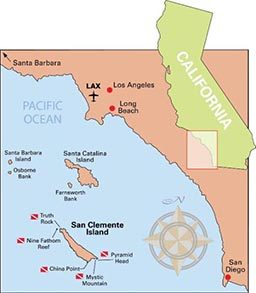
It’s hard not to think in military terms when you’re diving remote San Clemente Island, southern California’s best-kept diving secret. The 21-mile-long (34 km) island is the most southerly of the eight Channel Islands, and it’s owned by the U.S. Navy, which uses it as a combat training ground and bombing range. On your surface intervals, you can watch F-18s scream overhead or imagine what it must be like to be a SEAL scrambling ashore. But the best action is found underwater, on more than 12 dive sites that are open to civilians.

The sites are accessible only by infrequent multi-day charters, like the one we took aboard the Conception out of Santa Barbara. It’s a bit of a haul to get here, and the ever-present current can be a challenge, but the island gathers into one largely undisturbed place everything that seems rare at the other Channel Islands — pinnacles, steep walls, underwater arches and kelp-covered rock reefs, all populated by an unbelievable variety of marine life.


At Truth Rock, which rises from the bottom at 45 ft (14 m) to within 15 ft (5 m) of the surface, we anchor within view of what looks like a villa on a terrace overlooking the sea. This is no high-end beach house; Navy SEALs use this structure to stage amphibious assaults. Underwater, sheepshead abound, with females vastly outnumbering a few large males, and the combat for their attention is real. During the dive we see several female sheepshead approach each other head on, abruptly stop, bare their large mandibles, and break off, reverse course and quickly swim away.

Pyramid Head — a large, conical volcanic rock, one of several that sprout on the southeast corner of the island — is home to a quintessential kelp forest towering over a shallow reef. An outer wall steps down to a depth in excess of 100 ft (30 m), colored by yellow sponges intermixed with a variety of anemones. Ascending toward the surface, we take a kelp forest canopy tour and discover the wonders of mid-water diving. The ever-present opaleyes kiss the kelp fronds, kelp bass saunter about, and a silver sheet of bonito — one fish wide, by 50 fish deep, by several fish long — passes by like a shimmering mirage.

About a half-mile west and seaward of Pyramid Head lies Mystic Mountain, a conical shaped feature that rises from 140 ft (43 m) to about 65 ft (20 m) below the surface. The filtered light of an early summer’s morning illuminates a kinetic panorama. Large sheepshead plow the water. Blacksmiths swim through the current-loving red gorgonians. Golden seafans gently sway in time with the kelp.

Our last dive is China Point, where an extensive kelp mat shadows a series of low-profile reefs and narrow sand channels. We start the dive at about 65 ft (20 m) and head shoreward, where we find all the expected critters — lobster, garibaldi and blacksmith — in great numbers. We also spot a specimen of the really big fish this area is known for: calico bass, which turns and accelerates away from me, hugging the terrain like the fighter-bombers that buzz the terrestrial range above.

Our reconnaissance complete, we withdraw to the surface to ponder San Clemente Island’s dichotomies: isolation adjacent to a crowded coastline and peaceable diving in the midst of military operations. Diving this good is supposed to be impossible to find. Yet here it is, hiding in plain sight.

How To Dive It

Map of San Clemente Islands

San Clemente Island is owned and controlled by the U.S. Navy. Waters around the island are usually open to divers, though officials may restrict access to certain operating areas. Visit San Clemente Island for more information on closures.

Conditions: Average water temperatures are in the mid-60s°F (15°C), with lows in the low-to-mid 50s (10°C) in winter. Visibility ranges from 40-60 ft (12-18 m) in winter and spring and 60-90 ft (18-27 m) in summer and fall. San Clemente Island offers a variety of dive spots whose offshore location, deep water and variable currents combine to make for challenging intermediate to advanced diving.

Getting There: The island’s relatively remote location from the mainland means that it is not as frequently visited by charter dive boats as the other Channel Islands. Multiple-day liveaboard trips are the norm, with occasional all-day trips from the Los Angeles and San Diego areas.

Dive Operators: For more information on the Conception, which leaves from Santa Barbara, visit Truth Aquatics. For information on charters from other Southern California ports, visit California Dive Boats.

© Alert Diver — Q4 Fall 2009

Sunday, November 17, 2024

Tales from the Logbook--Feeding the Wolf Eel


One of the tasks I enjoy the most is feeding the wolf eel (Anarrhichthys ocellatus) in the Bird Habitat tank at the Alaska Sea Life Center.  This activity takes place at the beginning of the first part of the dive when I do a quick survey of the habitat for mussel shells, large kelp, and other debris that might get caught in the siphon used to clean the habitat surface.  I carry a large mesh goody bag to hold the items I collect.  A small side compartment contains the half dozen or so pieces of squid that I wolf eel.

As described my Milton Love, “wolf eels are marvelous eel-shaped fishes withextremely long bodies, large canines and molars, and dorsal and anal fins that taper together to form a point.  Adults are blue-gray, red-brown, or sometimes almost white, and darkly spotted (sometimes heavily, sometime not).  Females are sometimes brownish….Adults live over reefs or around hunks of human-made material.  You mostly see the adults with their heads sticking out of crevices and caves, although they will go out for undulating sojourns on occasion.”

Bird Habitat hosts a long rock-covered den near the side viewing window.  I seldom see the wolf eel, which is about four to five feet long, swimming freely the habitat.  Rather, she resides in the den face near one opening, tail near the other.  Taking one piece of squid out of the bag at a time, I dangle it near the opening of the den to coax her out.  Most of the time, she emerges from the den and pursues the squid that I hold in my fingertips.  Other fish in the habitat may try to move in on the morsel but the wolf eel is pretty adept at getting the squid.  Soon, all the pieces of squid are consumed and the wolf eel returns to its lair as quickly as it emerged. 

If guests have been watching the feeding, I turn to them hold up my gloved hand which held the squid, and with the index finger of the other hand count my five fingers and then pass my wipe my hand across my forehead to show relief that all five digits are intact.  It is a bit of a shtick, but the kids seem to really like it. 

Sometimes the wolf eel will not eat what is offered.   She generally refuses all food when she is fecund with eggs.  During that time, usually around October, we don’t attempt to feed her.

The Youtube videos below demonstrate the feeding of the wolf eel.


Sunday, November 10, 2024

Tales from the Logbook--Demonstrating Diver Hand Signals


In the summer of 2019, the education staff at the Alaska SeaLife Center in Seward worked with the habitat maintenance divers to develop an education program for the visitors.  The program emphasized the basics of scuba diving, the equipment divers used and how we communicated underwater using hand signals.  The five- to ten-minute program started just before the divers entered the water.  The narrator encouraged the youngsters to sit up close to the floor to ceiling window, with the adults near the back of the crowd. 

By the time we descended to the habitat’s floor, the program was well underwater.  The interpreter motioned the diver cleaning the window that communication would be demonstrated using hand signals that divers commonly use such as “up,” “down,” and “turn around.”  As I cleaned the windows rather than vacuum with the siphon, it fell to me to do the demonstration.  The interpreter had the crowd do the signal and I responded with the appropriate move.  Thumb up, ascend; thumb down, descend; and so on.  Sometimes the hand signal for “shark” would be indicated and I would feign fear and look nervously around the habitat.  The crowd loved it, especially the youngsters. 

At the end of the demonstration, guests would inevitably line up for photos with the diver.  On more than one occasion, I motioned for a group to gather in front of the window, as I reached into my dry suit’s external cargo pocket and produced an underwater camera like I was going to take their photograph.  After all the photos were done, I waved goodbye and started cleaning the window.  The demo then ended and the crowd dissipated. 

Every so often a youngster would linger or return and start flashing some of the hand signals.  I always took the time to execute the move indicated.

The interpretive program only lasted the one summer.  The following summer (2020) was at the height of the Covid-19 pandemic.  The Center was open, but only at a greatly reduced capacity and following the “stand at least six foot apart” guidelines.  Out of concern for our guests’ wellbeing, the program was suspended.  When the pandemic was over, the demonstration did not return. 


Sunday, November 3, 2024

Tales from the Logbook--The Supervisor


One of my most cherished images from my dives at the Alaska Sealife Center shows a youngster, probably about four or five years old, closely examining the results while I remove algal growth from the Bird Habitat window.  I call that image “The Supervisor.”  He appears to be fascinated with the all the activity between the suction cups which give me stability and leverage, the pad, and the diver.

A couple of weeks ago my Facebook Memories tab highlighted a post from October 2014 that I had done my first dive as a volunteer helping to maintain habitats at the Alaska Sealife Center in Seward, Alaska.  Ten years and more than 100 dives later, I can say that I look forward with anticipation to my next dive as I did my first.

I recall that Chip Arnold, the Chief Operating Officer at the Center, told me early on to be sure I interacted with the visitors, especially the children, during the dive if I had the opportunity.  Doing so is one of the best things about the job.  

During another dive, a youngster reluctantly approached the window.  With a little bit of encouragement from his mom, he pressed a phone against the window.  On the screen he had typed the message, YOU MISSED A SPOT.  I thought it was quite funny and appreciate the ingenuity that went into transmitting the message.

Most people are very receptive to interacting with me through the glass, but only the kids will really engage.  Some do so reluctantly, a bit shy at first.  I imagine a diver in all that gear can appear a bit scary.   Usually, I motion to them to come close to the window and initiate a “high five” or “fist bump.”   Pretty soon the parents are taking photos and video.  I try not to exhale during the photo shoot.  Pictures without exhaust bubbles are so much better than ones with them.  I stay there as long as there are kids looking to engage.    

Some encounters are more spontaneous.  A couple of ‘tweens started to mimic my underwater movement.  One did a seal hop across the floor which I repeated much to their delight. I upped the challenge by pushing off the bottom, going inverted and spinning in circles.  There are things a diver can do with the neutral buoyancy that can’t be replicated on the dry side of the glass.  Think of it as break dancing in zero g.